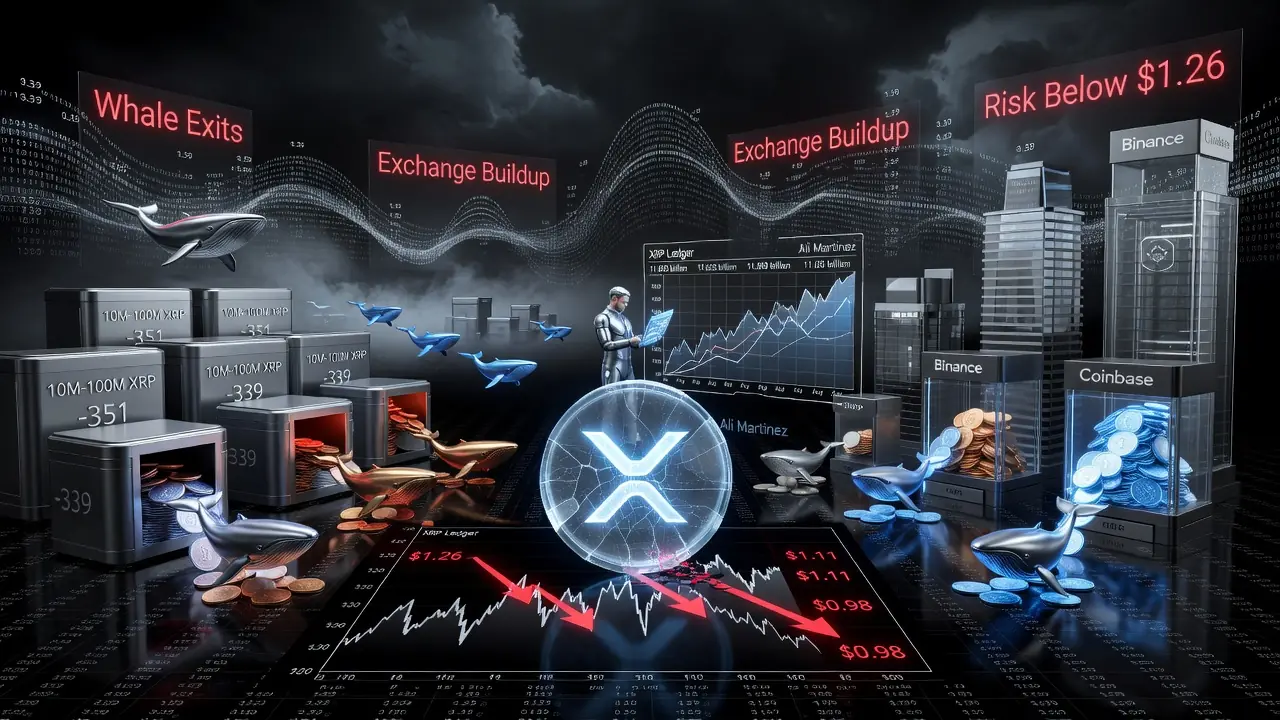
Analyst Ali Martinez says a cluster of on-chain signals is tilting against XRP in the near term, pointing to a drop in large-holder wallets, rising exchange balances, and a fragile technical support zone. He cautions that if these pressures combine, the token could slide toward $0.98, though he frames this as a conditional scenario rather than a certainty.
Whale Wallets Shrink While Exchange Reserves Climb
According to Martinez, the number of wallets holding between 10 million and 100 million XRP on the XRP Ledger fell from 351 to 339 over the past several weeks - a drop of 12 wallets. He interprets this as a sign that some large holders may be trimming their positions. At the same time, XRP held on cryptocurrency exchanges rose from roughly 11.003 billion to about 11.05 billion tokens, an increase of around 50 million XRP that has held steady over the past week. Martinez notes that when large holders move coins to trading platforms, it often signals intent to sell, which can add supply to the market and weigh on price.
The $1.26 Support Level Is the Key Technical Marker
Martinez's technical reading centers on a price channel XRP has traced since August, whose lower boundary currently sits near $1.26. He describes this level as the critical line separating stability from a deeper correction. Should it break, he projects an initial move down to $1.11, with the $0.98 mark - derived from the broader channel structure - as a secondary target if selling intensifies. A decline from $1.26 to $0.98 would represent an approximate 22% loss from that support point.
Reading the Data With Appropriate Caution
Martinez frames the bearish case around three specific observations: the decline in large-wallet counts, elevated exchange reserves, and the risk of a breakdown below $1.26. These are on-chain and chart-based indicators, not confirmed outcomes, and wallet movements can reflect custodial transfers, exchange rebalancing, or other activity unrelated to selling intent. Readers should treat this as one analyst's interpretation of available data rather than a forecast guaranteed to play out, and should not treat it as financial advice.